“Heroes make their own fate.”
-James
-

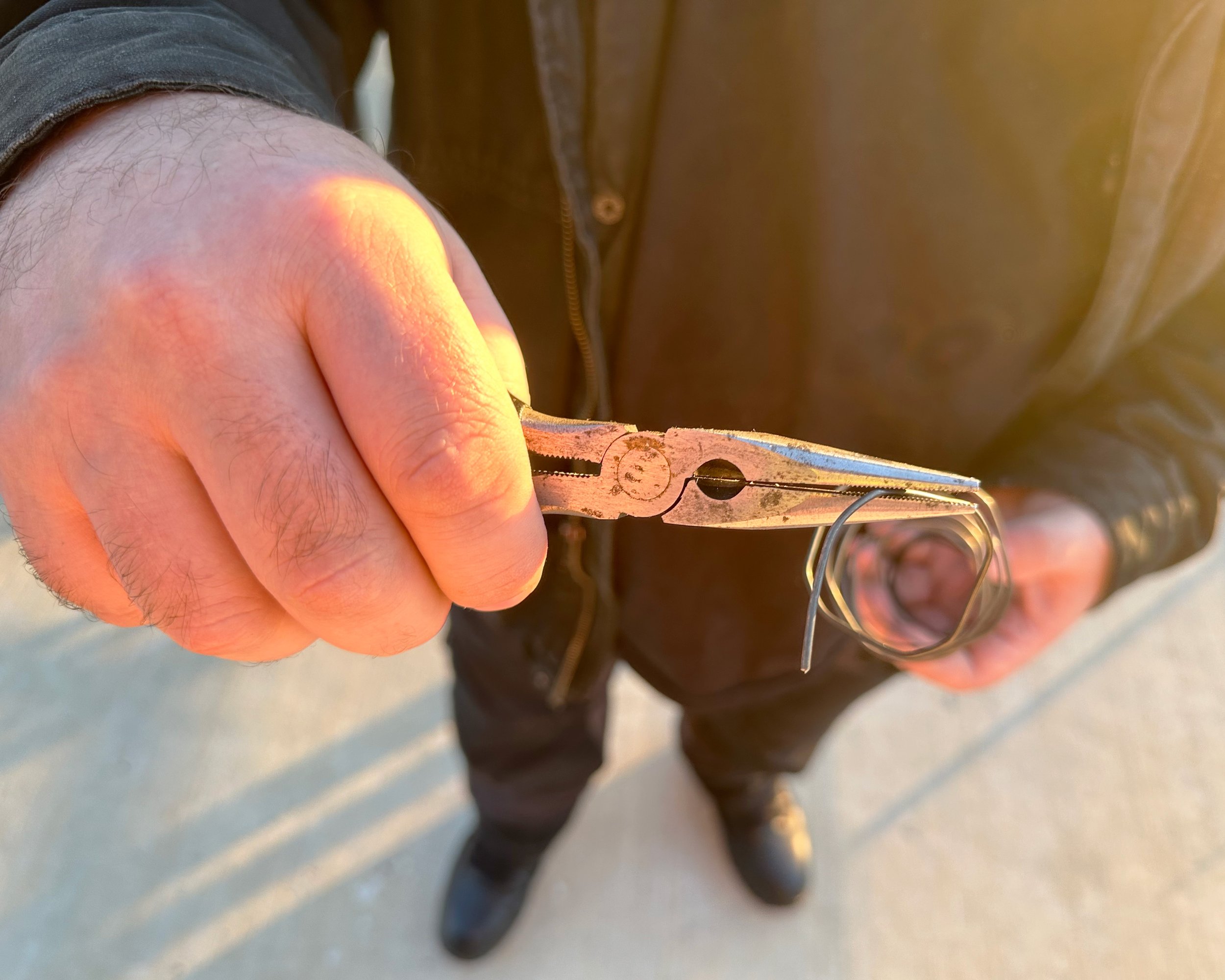
Arts writer Lauren Buscemi chats with James about his self-portrait.
James Marks (b. 1978) is a Louisiana folk artist who twists and wraps wire to make sculptures, usually in the form of human figures.
James is a sixth generation maker descended from five generations of craftspeople and tinkerers. Most were French Creole blacksmiths in St. John the Baptist Parish. His maternal great-great-great-grandfather, great-great grandfather and great-grandfather were blacksmiths. His maternal grandfather was a tinkerer. His father is a writer.
James’ maternal grandfather, Pa-Pa, taught him how to work with his hands. Pa-Pa built clocks. He also made James and his cousin a baby stroller from discarded items gathered from his workshop.
His grandfather died 20 years ago. James says he feels close to him every time he works with his hands. If you flip over James’ bigger sculptures you’ll find a brass turkey leg band. That’s something he got from Pa-Pa. He raised homing pigeons. He used leg bands on his pigeons to identify them. Today James uses the leg bands to number his larger pieces. Pa-Pa also taught James how to feed and identify birds, along with the pleasures of bird watching.
Whether you call James a folk artist, or a self-taught artist, or an outsider artist, he has been creating sculptures for a long time. He was four-years-old when he began making figures with bread twist ties. “My family ate a lot of stale bread,” says James.
As a boy he sculpted with different types of wire. Including computer cable twist ties, green grocery store produce ties, pipe cleaners stolen from his father’s smoking bag, and once even a tangle of downed power lines. His mom had to hide the boxes of trash sacks from James because he would take the wire ties ment to close them.
In high school James studied welding and eventually worked as a welder. But he kept returning to the wire. He has worked with wire for more than 40 years.
In 1995, while still a teenager, he began to attach his sculptures to utility poles around his neighborhood. This enabled James to master making humanlike figures from industrial wire because as he finished pieces he sent them into the world and didn’t have to worry about his creations taking over his family’s home. Once he started putting his work up he never stopped. He has always wanted community members to enjoy his sculptures. As you drive around Shreveport, you’ll spot his pieces. Some sculptures stay on the poles for years and others quickly get snatched up by people who love his work. He’s given away tons of his pieces over the years.
In 2004, after mastering the skill of figure making, James decided to preserve his technique by sharing his method with other people. Since then he’s worked with an incalculable number of children and adults to pass along how he makes wire figures. James has taught the art of wire sculpture for over 20 years throughout his community and at the Renzi Education and Art Center.
In 2022, the National Endowment for the Arts funded his innovative project "You as a Wire Hero."
Holding wire in his hands is how James navigates the world. Everywhere he goes he takes a small canvas bag filled with cutters, pliers, spools of wire, and even pipe cleaners. James is autistic and his way of stimming is by manipulating wire. Many of the small wire sketches he quickly bends into shape eventually become larger pieces.
His sculpture—"Oscar Joseph” is one of those larger ones. Named after his Pa-Pa, it’s in the permanent collection of the Shreveport Regional Arts Council.
The brightly colored piece is a near life-size tribute to his grandfather. Two decades after he died, Pa-Pa lives on when James’ shares his art and techniques with others and because his grandson created a tribute using thousands of strands of wires.
-

James On His Work:
“This is the real me, holed up somewhere with a bag of wire (or pipe cleaners in this photo). Twisting and wrapping wire lets me feel ok with myself. Some people call what’s going on with me ‘autism’ and twisting wire ‘stimming.’ Either way making sculptures is a shortcut to feeling comfortable—especially out in public.“
“I give my wirepeople out like gifts, sometimes directly to someone I know or want to get to know. Sometimes I leave them out like breadcrumbs— in forgotten or overlooked spots that catch my eye. I want to think that my ‘children’ will go on to be part of interesting stories. You just raise them right and send them out in to the world.”
-

Why LittleWireBird.com?
“About twenty-five years ago my friends Mary Bigelow and Matt Hazelton started a band that went on to become Dirtfoot. They wrote a song about me with this in the chorus—‘pretty little wirebird, pretty little wirebird, pretty little wirebird— from me to your voice.’ I’ve just kept that with me over the years. Not everyone is lucky enough to have a song written about their art.”